



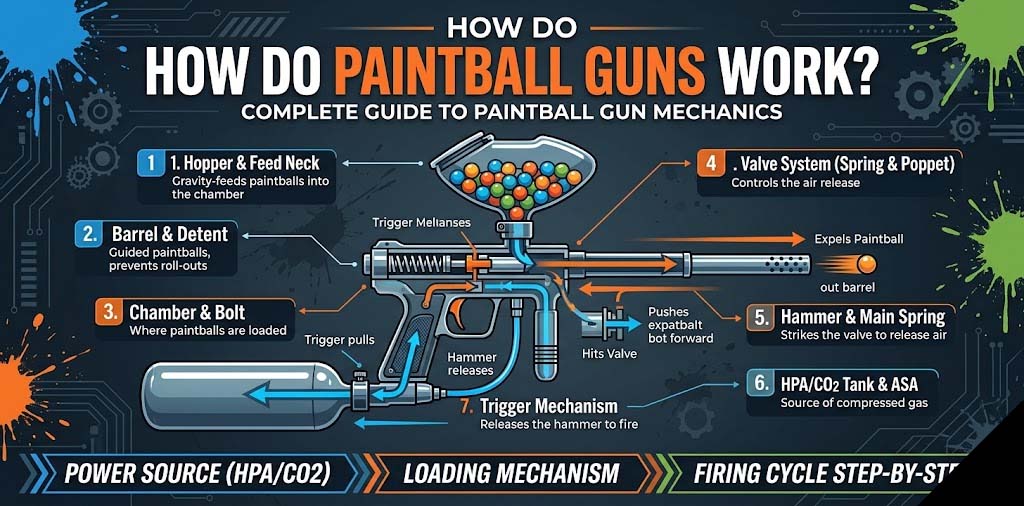
Discover the intricate mechanics behind paintball guns in this comprehensive exploration, revealing how these devices operate with precision and efficiency. From the fundamental principles to advanced technological features, this article offers valuable insights into their functionality, practical applications, and safety considerations. Perfect for enthusiasts and curious readers alike, it provides a detailed understanding of how paintball guns work in a clear and informative manner.
Introduction to Paintball Guns
Paintball has grown immensely in popularity as both a competitive sport and a recreational activity that emphasizes teamwork, strategy, and physical activity. Participants engage in simulated combat scenarios, using paintball guns to tag opponents with dye-filled capsules. Understanding how do paintball guns work is essential not only for enthusiasts seeking to improve their skills but also for ensuring safety and proper maintenance.
This article aims to provide a comprehensive overview of the mechanics behind paintball guns, exploring their fundamental principles, technological features, and practical applications. Whether you’re a beginner curious about the device’s operation or an experienced player looking to deepen your knowledge, this guide offers valuable insights into their functionality.
Fundamental Principles of Paintball Gun Operation
At its core, a paintball gun operates on basic physics principles involving the conversion of stored energy into kinetic energy to propel a projectile—in this case, a paintball. The operation involves several key components working in unison to fire, load, and feed paintballs efficiently.
There are various types of paintball guns, each with distinct mechanisms:
- Pump-action guns: Require manual cycling of a pump to chamber each shot.
- Semiautomatic guns: Use a trigger mechanism to fire one shot per pull, automatically chambering the next paintball.
- Automatic guns: Capable of firing multiple paintballs rapidly with continuous trigger engagement.
Common components across these types include:
- Barrel: Guides the paintball and influences accuracy.
- Hopper: Stores and feeds paintballs into the firing chamber.
- Trigger: Activates the firing process.
- Firing chamber: Contains the propulsion system and mechanisms for firing.
Understanding these basic parts lays the foundation for grasping how do paintball guns work in detail.
How Do Paintball Guns Work
Propulsion Systems in Paintball Guns
The core of a paintball gun’s operation is its propulsion system, which uses compressed gases to launch paintballs at high speeds. The two primary types of propellants are:
- CO2 (Carbon Dioxide): Stored in liquid form in small cylinders, CO2 expands rapidly when released, providing the energy needed to propel the paintball.
- Compressed Air (HPA – High-Pressure Air): Stored in high-pressure tanks, HPA offers more consistent pressure and performance, especially in varying temperatures.
When the trigger is pulled, the compressed gas is released into the firing chamber, pushing the paintball through the barrel at velocities often exceeding 200 feet per second. The difference between CO2 and HPA systems lies in their consistency and temperature sensitivity; HPA systems tend to provide more reliable performance.
Firing Mechanisms and Trigger Functionality
The firing process begins when the trigger is activated. In most paintball guns, pulling the trigger opens a valve that releases a controlled burst of compressed gas into the firing chamber. This sudden release of energy propels the paintball forward.
Valves and sears are critical components:
- Valves regulate the flow of gas, ensuring a precise amount is released per shot.
- Sears hold the firing mechanism in place until the trigger is pulled, releasing it to fire.
Depending on the gun type, firing can be singleshot—requiring a trigger pull for each shot—or rapidfire, where multiple shots are fired in quick succession, often facilitated by electronic firing systems.
Loading and Feeding Paintballs
Paintballs are loaded into the gun via a hopper, which feeds them into the firing chamber. The hopper design ensures a steady supply of paintballs to prevent jams and maintain firing consistency.
The feeding process involves gravity or agitation mechanisms that move paintballs into position. Common issues such as jams can occur if paintballs are deformed or if the feed mechanism is dirty or misaligned. Troubleshooting typically involves clearing jams, cleaning the feed system, or replacing damaged paintballs.
Advanced Technological Features and Innovations
Modern paintball guns incorporate advanced features to enhance performance, safety, and user experience:
- Electronic firing systems: Use circuit boards and sensors to enable fully automatic or burst firing modes, improving accuracy and rate of fire.
- Barrel modifications: Including rifled or ported barrels to improve accuracy, range, and reduce recoil.
- Safety features: Such as trigger safeties, eye protection sensors, and pressure regulators to prevent accidental firing and ensure user safety.
These innovations reflect ongoing technological advancements aimed at making paintball guns more reliable, precise, and safe.
Practical Applications and Safety Considerations
Paintball guns are widely used in various contexts:
- Recreational play: Casual games among friends or organized leagues.
- Competitive sports: Professional tournaments emphasizing speed, strategy, and skill.
- Training scenarios: Military and law enforcement training for tactical exercises.
Proper handling, regular maintenance, and the use of safety gear—such as masks, gloves, and protective clothing—are essential to prevent injuries. Understanding how does paintball gun work helps players operate their equipment responsibly and effectively.
Legal regulations vary by region, often requiring adherence to safety standards and restrictions on modifications. Responsible use and adherence to local laws are critical to ensuring the safety and enjoyment of the sport.
Conclusion
In summary, understanding how do paintball guns work involves appreciating the interplay of physics, mechanics, and technology. From the propulsion of paintballs using compressed gases to the sophisticated electronic firing systems, each component plays a vital role in the device’s operation.
For enthusiasts and players, grasping these mechanics enhances both performance and safety. As technology continues to evolve, future trends may include even more precise, efficient, and safe paintball equipment, further enriching the sport and recreational experience.
By mastering the fundamentals of how does paintball gun work, players can improve their aiming skills, understand safety considerations—including can a paintball gun kill you—and enjoy the sport responsibly. Whether for competitive play or casual fun, knowledge of these devices ensures a more informed and enjoyable experience on the field.