



Paintball is an equipment-heavy sport that requires a loader to hold the paintballs, a mask to protect the face and eyes, and a marker with propellant to shoot the paint for a safe game. A barrel sock or marker plug is also required to guarantee safety off the field.
Players may opt for additional equipment like gloves, a paintball pack, a squeegee, or padding to reduce the impact of incoming paintballs.
Paintballs are protected by a shell similar to that of a vitamin. In the factories, pharmaceutical businesses that produce vitamins and other goods that need to be encapsulated already have this technology. These firms encapsulated the majority of paintballs when the sport was originally established.
After being manufactured at a different location, the paint filler was shipped to the encapsulating factory. They were distinct processes. Due to the cost and upkeep of the encapsulating technology, this was a two-company procedure before the sport’s rise in popularity.
As paintball games became more and more popular by the year 2000, specialist businesses that produced paintballs began to appear. Among the first were Brass Eagle, R.P. Scherer, and Zap Paintball Manufacturers.
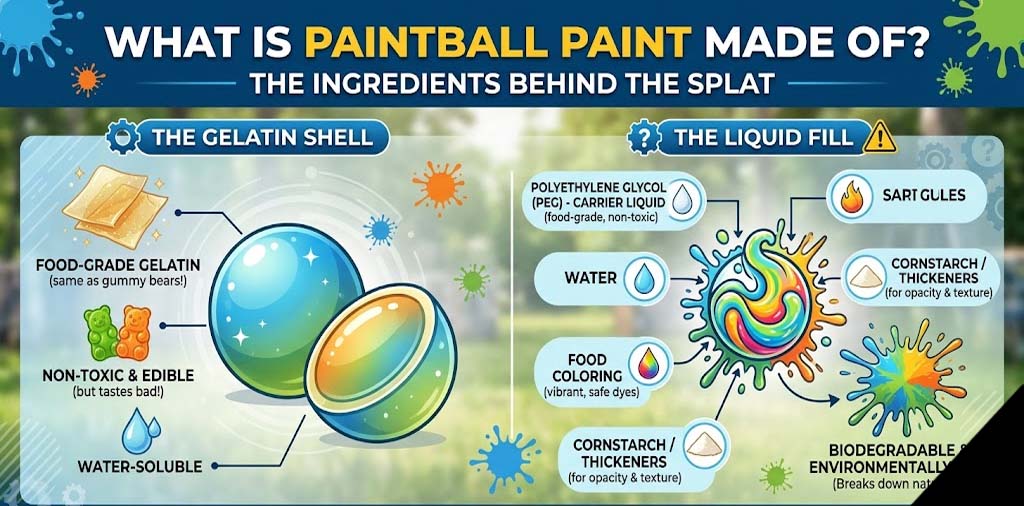
The paint used in paintball is specifically designed to be safe and washable. It is water soluble, biodegradable, and harmless to the environment. The ingredients of the paint typically include iodine, food coloring, ethylene glycol, and mineral oil, all of which are non-toxic. The encapsulation of the paint is made using gelatin, which is a safe and commonly used substance. This makes the paint easy to wash off clothes and skin, ensuring that it does not cause any harm to the players or the environment. Overall, the paint used in paintball is designed to be safe and easily removable.
It’s important to note that Paintball USA uses paintballs of the highest caliber produced by reliable suppliers, ensuring the safety of all players.
Paintball, Explained
Paintballs are round capsules made of gelatin that are loaded with a water-soluble, non-toxic “paint.” They are shot in a paintball match from a gun or “marker.” The idea is to signify that a player is out by leaving a mark or tag behind. The paintball’s fill or dye is what gives paintballs its iconic “splat” that everyone remembers.
The capsules are made of a liquid interior and a pliable exterior, similar to soft plastic or gel, even though they may feel very substantial. Although other reusable forms don’t leave much of a mess behind, paintballs are made to explode on impact (more on that below). Additionally, if a paintball marker is hit from a distance, it may occasionally bounce off the player due to the paintball’s decreased velocity.
The part that typically rests on top of a marker is called the hopper, and it is through this that paintballs load into the firing chambers of the marker. However, some paintball guns employ magazines instead, which gives the markers a far more realistic appearance akin to a real gun.
Paintballs are usually .68 caliber, but certain guns may need different sizes like .43 or .71 caliber. They are round but can become misshapen due to factors such as heat. The gel capsules can also absorb water and swell, so be cautious of using a paintball found on the ground as it may jam in your marker’s barrel.
What Is The Outside Of A Paintball Made Of
Paintball shells are typically made of a solid yet malleable material that can maintain its shape when fired, but will burst upon impact with a target. The exterior is commonly composed of cellulose acetate, gelatin, or plastic.
What Is Inside Of A Paintball
Paintballs contain a water-soluble dye, which is the filling that leaves a mark upon impact. It is important to note that the fill’s color may differ from the color of the paintball shell. For instance, Valken Tango Paintballs have a purple shell but contain a bright orange fill. This dye is designed to be easily washed out of clothing.
Paintballs are made using a variety of ingredients commonly found in food products, such as wax, gelatin, sorbitol, canola oil, and soy lecithin. These food-grade ingredients ensure that the paintballs won’t harm the environment when washed away and also eliminate the concern of accidentally ingesting them if they come into contact with your mouth during a game.
In the early days of their invention, markers were made of glass and filled with oil-based paint. However, with the current encapsulation process, markers are much safer, especially when playing paintball with kids.
Certainly, due to the paint inside paintballs, they may cause a stain upon impact.